
Project Description
WYWSF GIA Final Report
Grant # R01491
Project Title: Ferris-Seminoe Bighorn Sheep Monitoring Project
Award Amount: $44,250
Amount Expended: $44,250
Project Accomplishments Summary
WGFD utilized the WYWSF GIA funding to acquire and deploy 50 GPS transmitters, which included collars and ear tags, for bighorn sheep. These transmitters were deployed in January 2025 on ewes and rams within the Ferris-Seminoe Bighorn Sheep Herd Unit and are programmed to transmit data until Fall/Winter 2026. Through 2025, over 82,000 marked bighorn sheep GPS locations have been collected. These location data from the marked bighorn sheep are essential for multiple management objectives including: 1) Monitor movements outside the herd unit boundaries to reduce the risk of bighorn sheep commingling with domestic sheep on nearby allotments; 2) Evaluate bighorn sheep habitat use and inform the update of seasonal range delineations in 2025; and 3) Improve the accuracy of annual trend surveys and an upcoming sightability survey, which will result in a better estimate of the population.
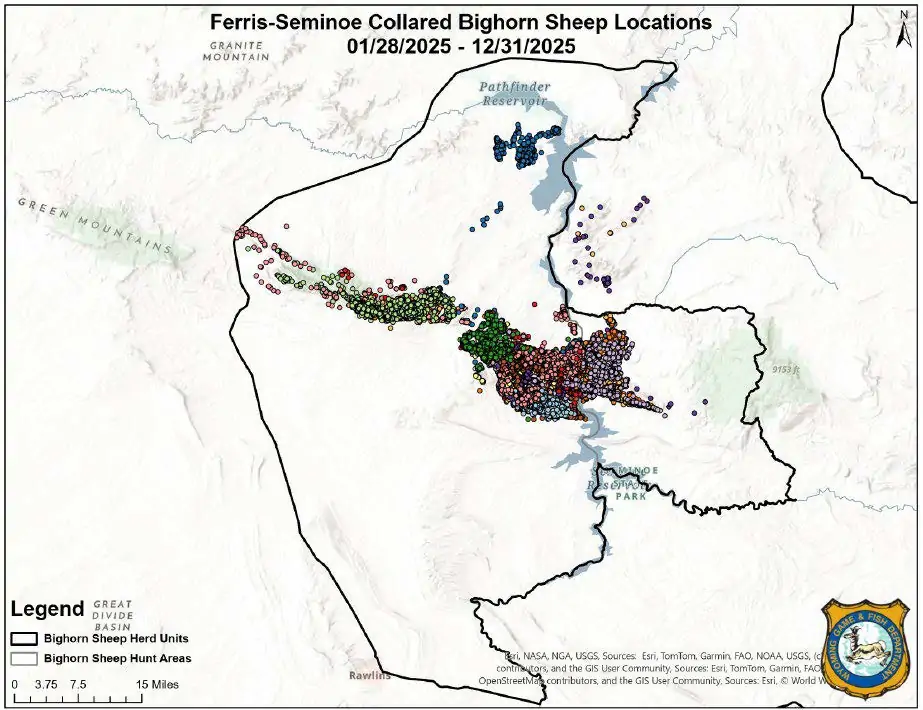
Marked Ferris-Seminoe Bighorn Sheep Locations January 2025 – December 2025.
The Ferris-Seminoe Bighorn Sheep Herd Unit holds a unique status in Wyoming: it is the state’s only herd currently free of pathogens such as Mannheimia haemolytica and Mycoplasma ovipneumoniae. This makes it an essential resource for future bighorn sheep reintroduction and transplant efforts throughout Wyoming. Following the 2019 Pedro Mountain Fire, the resulting habitat has been enticing bighorn sheep to move north of Herd Unit, potentially bringing them closer to domestic sheep and increasing the risk of disease transmission. To safeguard this vital population, the Wyoming Game and Fish Department (WGFD) has ramped up its monitoring efforts, which are generously funded by the Wyoming Wild Sheep Foundation and the Wyoming Governor’s Big Game License Coalition.
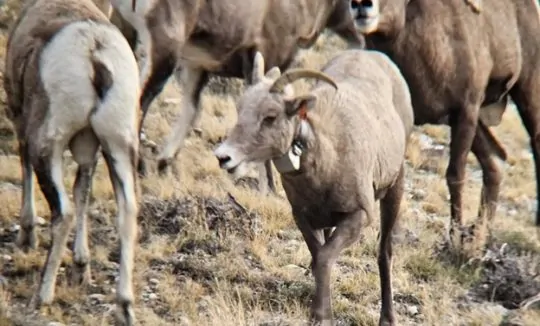
Marked Ferris-Seminoe bighorn sheep ewe observed during the November 2025 rut.
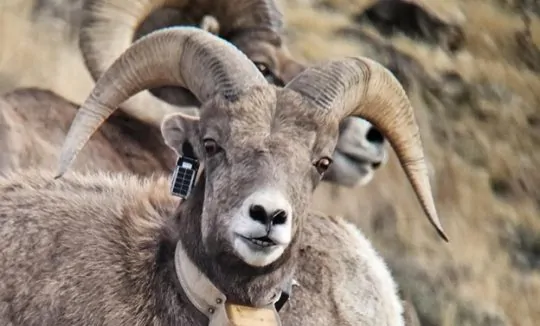
Ferris-Seminoe bighorn sheep ram, tagged with a new GPS ear tag in winter 2025-2026. The updated ear tag shuttles (tan) are designed to minimize the loss of the tags.
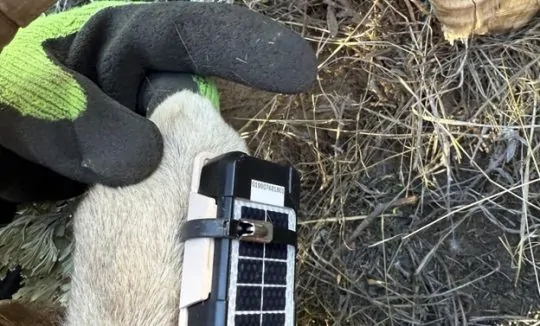
Ferris-Seminoe bighorn sheep ram, tagged with a new GPS ear tag in winter 2025-2026. The updated ear tag shuttles (tan) are designed to minimize the loss of the tags.
Key Monitoring and Analysis Updates
As part of the Ferris-Seminoe Bighorn Sheep Monitoring Project, WGFD managers have collared and GPS ear-tagged bighorn sheep ewes and rams to track their movements, especially into the re-vegetated Pedro Mountains. From 2020 to 2024, 28 bighorn sheep were collared in the Bennett Mountains and Miracle Mile area. In winter 2024-2025, 20 additional bighorn sheep were GPS tagged/collared in the Bennett and Miracle Mile area, with 24 more collars deployed across other parts of the herd unit. These collars and GPS ear tags will be maintained through 2026.
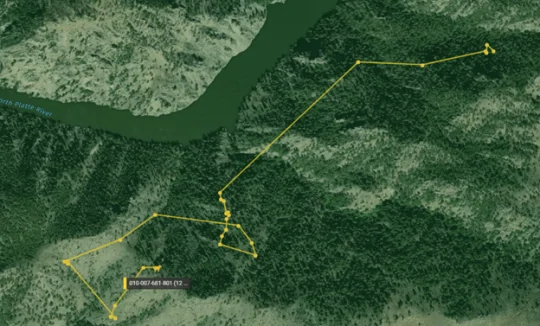
Example of GPS locations transmitted every 2 hours via a GPS ear tag on a Ferris-Seminoe bighorn sheep ram.
Recent and ongoing analyses of collar data are providing vital information for management. The Omniscape Analysis predicts movement between sub-herds to understand the landscape-level transmission of disease, and the Risk of Contact Tool estimates the sex-specific probability of a bighorn sheep moving into a domestic allotment. These analyses are crucial for understanding how disease could spread among herds, which informs decisions regarding population size, density, and the need for future transplants. The Wyoming Wild Sheep Foundation provided significant funding for these analyses, similar to their contribution to the Ferris-Seminoe Bighorn Sheep Monitoring Project. WGFD plans to continuously update these analyses using the collar data collected from the Ferris-Seminoe Bighorn Sheep Monitoring Project (2020-present). Furthermore, they aim to enhance these datasets with more precise location data, particularly from bighorn sheep exhibiting foraying or wandering behavior.
Looking Ahead: Population Assessment
The herd is managed with a mid-winter trend count objective of 240 to 360 animals, with the current three-year average sitting at 278 bighorn sheep. Traditional aerial trend counts are becoming increasingly difficult. To ensure accurate population data, WGFD is launching a new plan to conduct an aerial survey using established sightability-correction methods. Furthermore, they are developing a sightability model specific to Wyoming bighorn sheep habitats, utilizing the deployed GPS collars to conduct trial runs. This innovative methodology will establish a stable, long-term monitoring framework. It is expected to allow intensive, resource-intensive surveys to occur only every 5 years instead of annually, resulting in significant long-term cost reduction while maintaining high-quality, reliable population data for management decisions.