
Project Description
Teton Bighorn Sheep Nutritional Carrying Capacity
Bighorn sheep, particularly those in alpine environments such as the Targhee, Whiskey Basin, Jackson, and Absaroka herds, experience dramatic seasonal fluctuations in forage availability. At high elevations, forage quality peaks early in summer and begins to decline rapidly during autumn, creating a potential nutritional bottleneck as winter approaches. Despite the importance of nutrition as a factor limiting survival and reproduction in bighorn sheep, our understanding of their diet and the capacity of alpine habitats to sustain resident populations remain poorly understood.
Our project aims to help close this gap by estimating nutritional carrying capacity of bighorn sheep in the Teton Range, which, as the smallest and most isolated of Wyoming’s four native core herds, is a priority for future conservation efforts. Nutritional carrying capacity is defined as the number of animals that a landscape can support based on availability and quality of forage, movement behavior, and dietary decisions of individuals. Historical accounts indicate that the Teton Range once supported a greater number of sheep than are currently present, and reasons for this trend could be related to nutrition. Teton sheep once had access to low-elevation winter ranges, but habitat fragmentation, fire suppression, and land use changes have now restricted their range to higher elevations year-round. Considerable resources have since been invested to accurately estimate population abundance, to protect wintering habitat, and to remove competing non-native mountain goats from the range. Quantifying nutritional carrying capacity is a critical next step in management of this population and will help managers establish realistic population objectives and develop strategies for sustaining or increasing the population.
To provide a science-based estimate of nutritional carrying capacity, our project combines intensive vegetation sampling, movement data, dietary analysis, and information on the nutritional requirements of reproductive ewes to model the nutritional landscape. Key variables such as the quality and biomass of forage plants will be used to create dynamic maps that track variation in forage availability and quality in both space and time. These maps will allow for an assessment of forage availability during critical periods such as summer and autumn when the nutritional needs of lactating ewes are greatest, and when sheep accrue critical fat reserves to survive winter. Moreover, understanding how ewes, which drive population growth, use the nutritional landscape available to them is central to determining whether nutrition interacts with other factors such as predation risk to limit population performance.
Another key component of our project is quantifying diet composition of alpine bighorn sheep. Despite the critical role of diet in shaping the health and survival of bighorn sheep, little is known about their specific dietary choices in alpine environments. Fecal samples will be collected and analyzed using DNA metabarcoding to identify which plant species are consumed by sheep and in what proportions. These data will provide a detailed understanding of how diet shifts seasonally in response to changing forage availability and of how individual diets differ within the population. Linking diet composition to the availability and quality of forage will help wildlife managers better understand how bighorn sheep adjust their foraging strategies to meet their nutritional needs in the face of various constraints. This information is crucial for understanding how sheep navigate periods of nutritional scarcity and how diet impacts individual performance and population dynamics.
In addition to providing valuable information for managing the Targhee herd, the methods and tools developed during this project can be applied broadly to other alpine herds in Wyoming. For example, our models can be adapted for application to the Whiskey Basin, Jackson, and Absaroka herds, which occupy similar high-elevation environments and face comparable limitations in forage availability.
Finally, these tools can also be used to assess prior efforts by the Wyoming Wild Sheep Foundation to protect sheep habitat and reduce the risk of disease in the Targhee herd. The foodscape model developed under the other project objects can be used to assess former grazing allotments in the Caribou-Targhee National Forest that were purchaed by the Wyoming Wild Sheep Foundation in the 1990s, as well as other allotments that were previously adminstratively closed by the Forest Service
2/2026 Photo Captions/Context
Photos/Info: Ryan Martin with the University of Idaho
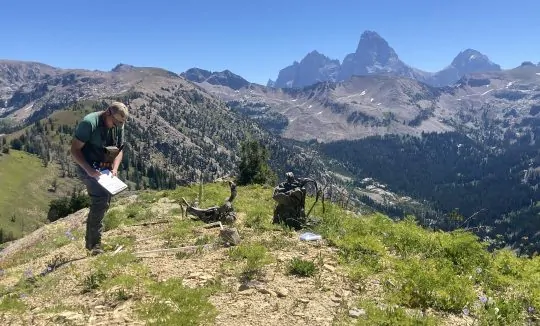
IMG_7128.heic – This is a photo of Ryan Martin collecting vegetation data in the Tetons to assess forage quality and availability within the Targhee herd range. The view from the camera looks east toward Grand, south toward Middle Teton, and west toward the Tetons.
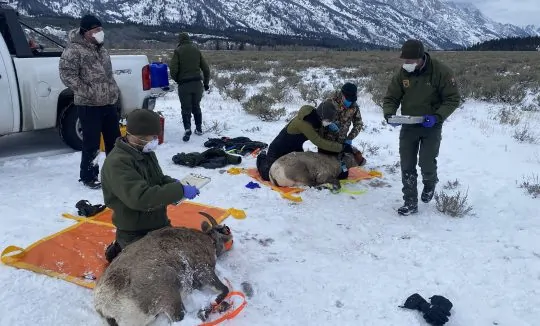
IMG_5445.heic – This is a photo from our first year of capture and collar operations. In collaboration with the National Park Service, we collared 27 adult ewes throughout the range. The photo shows biologists processing and collecting data from ewes captured and transported by helicopter net gun.
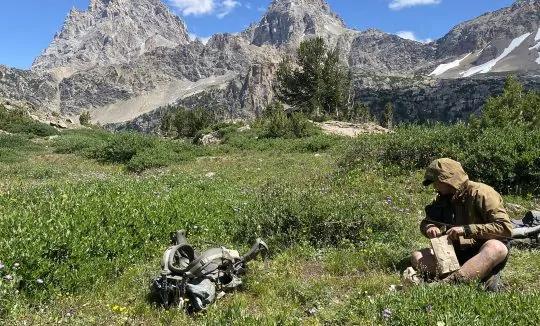
Grand-Middle-South.jpeg – This is a photo of Ryan Martin collecting vegetation data from South Cascade Canyon near Avalanche Divide in the Teton Range. Grand, middle, and south Teton are in the background.
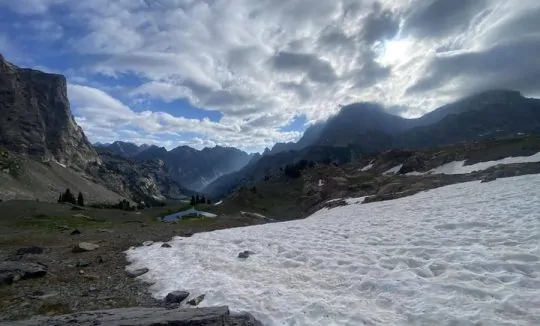
Avalanche-Divide.jpg – Here is a picturesque view looking down South Cascade Canyon from Avalanche Divide.
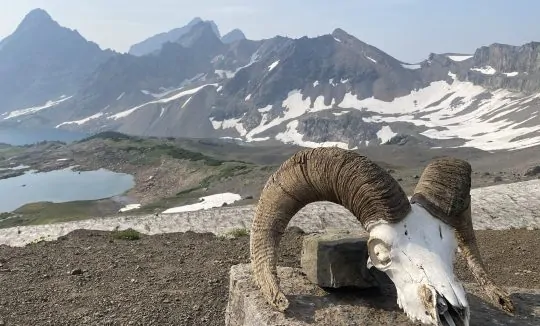
This is a picture of a ram skull we found on a ridge between two high passes. The background is a bit smoky due to the Fish Creek fire.